Monday, January 23, 2012

My Cotton Story

Hard-copies of "Jacob's Tails. . .ALL GONE!!

(The last 4 copies were left at In-a-Pear-Tree in Casa Grande)

*****************************

The E-Book is available through

Smashwords

***

Barnes & Noble

***

Chapters/Indigo

*****************************

By the time we left Rovers Roost, Casa Grande, (January 12, 2012) we both felt the need to get back to the desert.

Rovers Roost is a great place to spend our mid-winter park time – we do enjoy the attitude; the activities; and the camaraderie. Our Escapees buddies, Diane and Andy introduced us to Shelly and Bill and Miles (an 8 month old Scotty) who became Escapees buddies very quickly. But – we miss the space and quiet.

I was able to initiate exercise sessions three times a week using the same Strength for Seniors series that they had at POS, Coarsegold (near Yosemite) and folks seemed to enjoy it. Katy took it over and I expect it will still be going on when we get back next year.

I’ve Always Loved Cotton!

While we were there, I again became intrigued with the cotton in the fields: how it grew and was harvested. Then there was the cotton gin down the road from the park - the whole yard was just packed with those huge cubes the size of railway cars.

For years we had seen those massive bales sitting out in the field and on a rare occasion, we saw a field with plants and straggles of cotton clinging to them. This year there were still crops sitting in the fields: some still maturing; some ready and waiting to be harvested; and we were even able to finally see the machinery harvesting the cotton.
HeatonPickers

Working Field2

cotton1

They don’t pick by hand any more!

To this point my total exposure to harvesting cotton was from movies that showed folks in the field with sacks on their back bent over and picking cotton and singing.

The machinery is fascination.

First came the picker-

cottonpicker2

that could pick one row at a time. The invention of the mechanical picker, apparently revolutionized the South. They claim that “the picker played an indispensable role in the transition from the prewar South of over-population, sharecropping, and hand labor to the capital-intensive agriculture of the postwar South.

Today, they pick up to six rows at a time.

NewPicker1

and dump the cotton into the basket in one operation.

Compacter

And then it goes into the compactor.

NewPicker

And it comes out here!

Those huge modules (as they call them) sit on the road beside the fields until they can be ginned – that is the cotton is cleaned separated into fibres and seed.

It used to be done painstakingly by hand

image

until Eli Whitney finally patented his Cotton Gin (short for cotton engine) in 1793.

Another stroke of Luck!

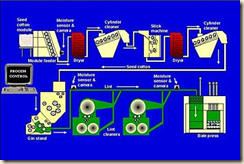
We went over to the Lummus Cotton Gin (just down the road from where we were staying) and I sat with a couple of gals there and they explained some of the ins and outs of the industry to me.
image

(This is a copy of the Diagram of a modern cotton gin plant, displaying numerous stages of production from Wikipedia)

There is considerably more cotton this year because of the higher prices. Over 600 modules of raw cotton sit in their yard. Usually they are finished processing the cotton by mid January. This year they guesstimate it will be March before it is all done. Cotton Gin Yard (9)

The ginning process cleans the raw cotton and separates the modules into cotton fibres for fabric (that is compressed into bales) and the pyramids of seed that sit in the yard. The gals at the Plant said that one module will produce about 15 bales.

IMG_4631

And seed that is used in all sort of things like animal feed, fertilizer and cotton seed oil. The oil is then refined further for lotions and soaps.

IMG_4635

There is talk about using the rest of the waste for biofuels.

They lose track of the bales after they are trucked to a cotton broker. The gals figure that most of the fibre goes overseas to be spun and woven into fabric.

So – that’s my Cotton Story!

http://en.wikipedia.org/wiki/Cotton_picker

http://eh.net/encyclopedia/article/holley.cottonpicker

http://casa_grande-az.yellowusa.com/Cotton_Gins.html

http://en.wikipedia.org/wiki/Cotton_gin#Modern_cotton_gins

http://inventors.about.com/od/cstartinventions/a/cotton_gin_2.htm

Sunday, January 8, 2012

Saguaro National Park: Bookend Parks of Tucson

Rovers Roost (Casa Grande) become our base and we have gone back and forth to Tucson a few times.

The first trip was to West Saguaro NP. West and East Saguaro National Park sit like bookends on either side of the city. The West side seemed to have more of what we wanted to visit.

It made me think of a forest – if there is such a thing as a Cactus Forest.

A Ranger recommended that we might like to try the Signal Hill Trail that led up to some interesting petroglyphs (Rock Art) and a great panoramic view.

The area was developed by the Civilian Conservation Corp (CCC) who were FDR’s answer to unemployment during the Depression of the 1930s.

Corps of men were fed, educate, housed and paid $1.00 per day (75% of which was sent back to their families) in exchange for developing the various national sites.

They think that the petroglyphs were left by the Hohokam people thousands of years ago. There is little know about these people or the rock art that they left behind but it is probably akin to the graffiti of today.

IMG_4541

IMG_4544

The Saguaro Cactus is fascinating – from it’s humble beginning to its haunting shape that’s become a symbol of the desert for me.

The Saguaro can only propagate from seed and under specific conditions. It is very sensitive to frost and wind and needs heat and moisture. The Saguaro is found only in the Sonora Desert.

The cactus usually begins life being sheltered by a "nurse" tree or shrub (a Creosote, Mesquite or Palo Verde) that provides shade and moisture to help it grow. So you often see the Saguaro surrounded by bushes.

Eventually the cactus takes most of the nutrition and the nurse plant dies.

IMG_4549

The Saguaro grows very slowly –maybe an inch a year - but to a height of 15 to 50 feet. The largest plants, with more than 5 arms, are estimated to be 200 years old. An average old Saguaro would have 5 arms and be about 30 feet tall. The one in this photo has 7 arms and we’ve seen cactus with a whole lot more.

Prickly spines run vertically along the entire length of the cactus. After a heavy desert rain, the spines are further apart when the cactus swells by absorbing the moisture. As the desert dries out, the spines come closer together,

It’s almost impossible to find a Saguaro that has no damage. Birds (particularly the cactus wren) build their nests time and time again in small holes in the cactus. Once there is a nest there, the cactus develops a kind of callus around it to conserve the moisture and protect itself. This callus is what they call a boot.

I’m not sure if you would call it an injury, but a crest can develop on the top or between the arms of the Saguaro. A friend of ours (Sheila) has a list of highway mile markers where she has seen the crested Saguaro.

PC090068

The question that puzzles me the most is: What triggers the growth of an arm? Every time I ask, I get a different answer: when the rains are heavy, the arms allow the cactus to absorb more moisture for when there is a drought; because the Saguaro only propagate by seed, more arms develop when the plant seems threatened; and finally, why do other trees produce their branches? Interesting, eh?

Cactus-Why (3)

Monday, January 2, 2012

The Arizona-Sonora Desert Museum

The Museum sits on 98 acres with 3.2 kms (2 miles) of walking paths covering 21 acres. Much of the property is covered with natural growth and cacti.

IMG_4355

Hedgehog

Hedgehog

Saguaro Cactus with Crest

CrestedSaguaro

A Crest can be developed when the growing point, or merristem (which produces new stems and spines or leaves), elongates into a line. In time the growing line may become greatly convoluted, like a brain. This phenomenon has been observed in nearly all plant species; its cause is generally not known”(sign near the cactus)

SuguaroCrest

The Museum offers all kinds of guided tours and demonstrations throughout the day. We chose to go to the Raptor Free Flights demonstration that featured a Peregrine Falcon.

There were three trainers working the birds. They were able to communicate with each other and could somehow direct the flights of the birds. The birds would dive and swoop down over our heads and then  perch on a branch or cactus to have their pictures taken. Like I said, we took over 150 photos – it was so difficult to decide which ones to share!

Raptors

Owls

BarnOwl

Barn Owl

Owl

Hawks and Falcons 

Falcon

IMG_4370 (2)

IMG_4373 (2)

IMG_4391 (2)

IMG_4393 (2)

IMG_4395 (2)

Hummingbirds

Hummer (1)

Hummer (2)

Hummer

Resting Cougars

Cougars

Bob Cat

BobCat

Need I say it was a memorable visit?

Sunday, December 18, 2011

Tucson . . . Here We Come . . .

A stop at the Rovers Roost Escapees RV Park in Casa Grande was not in the plans but when Fred said his back was bothering him, Rovers Roost was the right place to rest up before we went to Tucson.

We were in Tucson last year but our visit was interrupted by THE shooting (what I call the Safeway massacre) that left me just wanting to get out of there. This was our chance to come back and explore all the places we didn’t get to as well as those we wanted to revisit.

Tucson and the surrounding areas are exceptionally diverse and the inhabitants share and celebrate that diversity. It is a city built in and surrounded by volcanic mountains and desert. Even the name Tucson is derived from a Spanish adaptation of the O’odham word for at the base of the black hill - Cuk Ṣon.

Our first stop was at the Visitor Information Center downtown. Downtown is an array of colour and lines - the plazas, the buildings, the streets – and history.

They offer a special Passport that offers special attractions discounts so we stopped to pick one up.

Jewish Historic Museum

One of the places in the passport was the Jewish Historic Museum so I thought it might be interesting to see. I was quite surprised first that there are so many Jewish people in Tucson and then that the first synagogue was reform built in 1902.

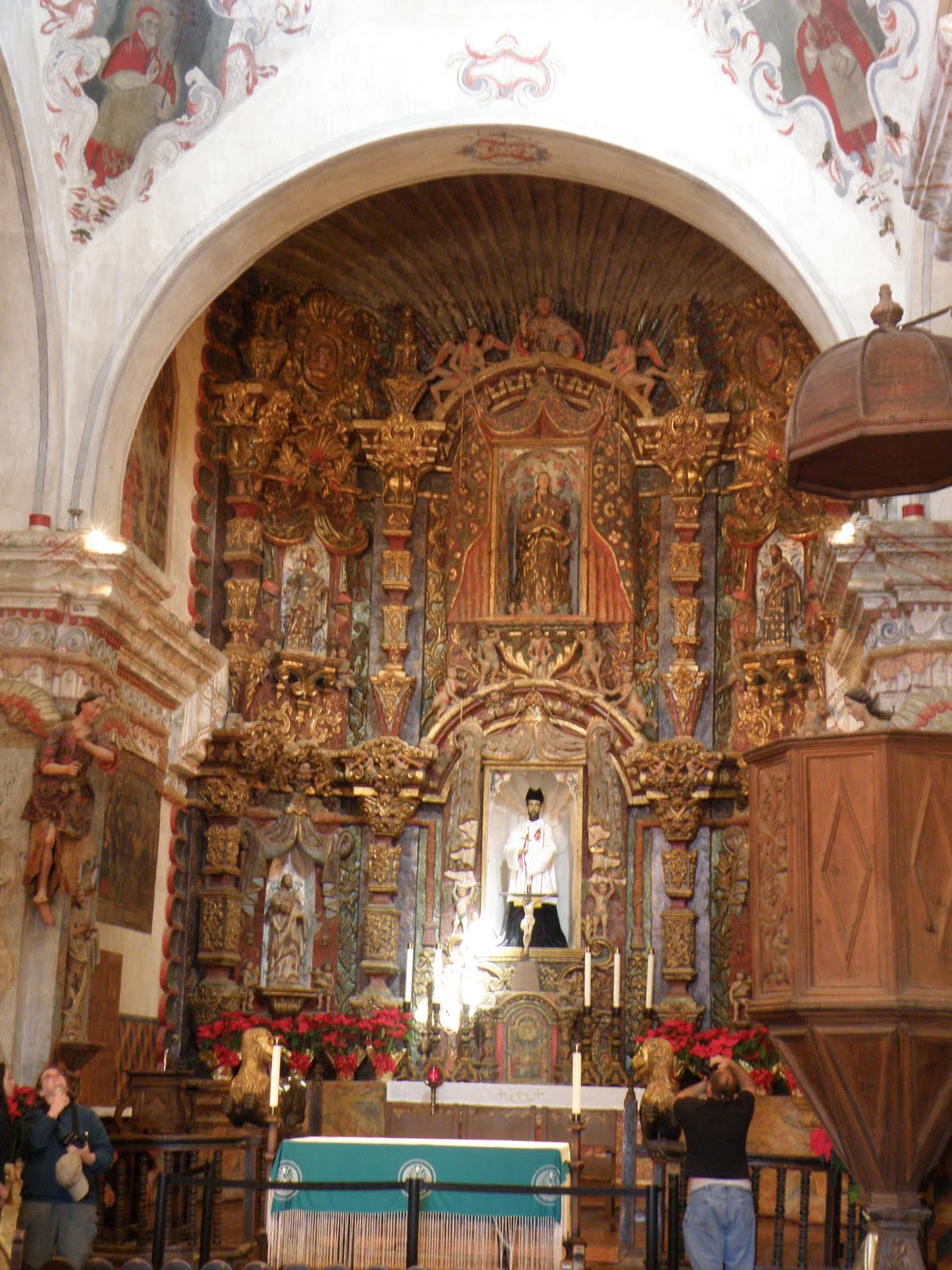
Mission San Xavier

Archaeologists claim that the area was visited by Paleo-Indian people as long ago as 12,000 years and there is evidence of irrigated farming and the red and black ceramics of the Hohokam Peoples.

The first Catholic mission of San Xavier founded by Father Eusebio Kino in 1692 still stands and is the oldest intact European structure in Arizona. It’s been named a National Historic Landmark.


The Arizona-Sonora Desert Museum

There is no question that the Museum is our favourite attraction in Tucson. We spent most of the day there (we were there last year) and this time took part in the Raptor Free Flights demonstration.

The museum is spectacular . . . it sits on 98 acres with 3.2 kms (2 miles) of walking paths covering 21 acres. Much of the property is covered with natural growth and cacti. All sorts of plants line the walkways many are named and labelled for identification. There are snake and reptile exhibits; hummingbird and other bird enclosures; and large animal like Cougars and Bears that are housed in very natural settings. What with my camera and Fred’s new camera, we took over 150 photos. (So - I’m going to do a separate posting on the Desert Museum once I get the photos sorted out!)

DeGrazia Gallery in the Sun

It’s difficult to describe the DeGrazia Gallery in the Sun experience. The gallery is a complex of buildings scattered over 10 acres in the hills in north Tucson. The buildings and the setting exemplifies the spirit and backdrop surrounding the entire city – natural desert with an array of plants and cacti. Impressionistic sculptures and settings are sprinkled throughout and that is even before you go into the sanctuary or gallery.

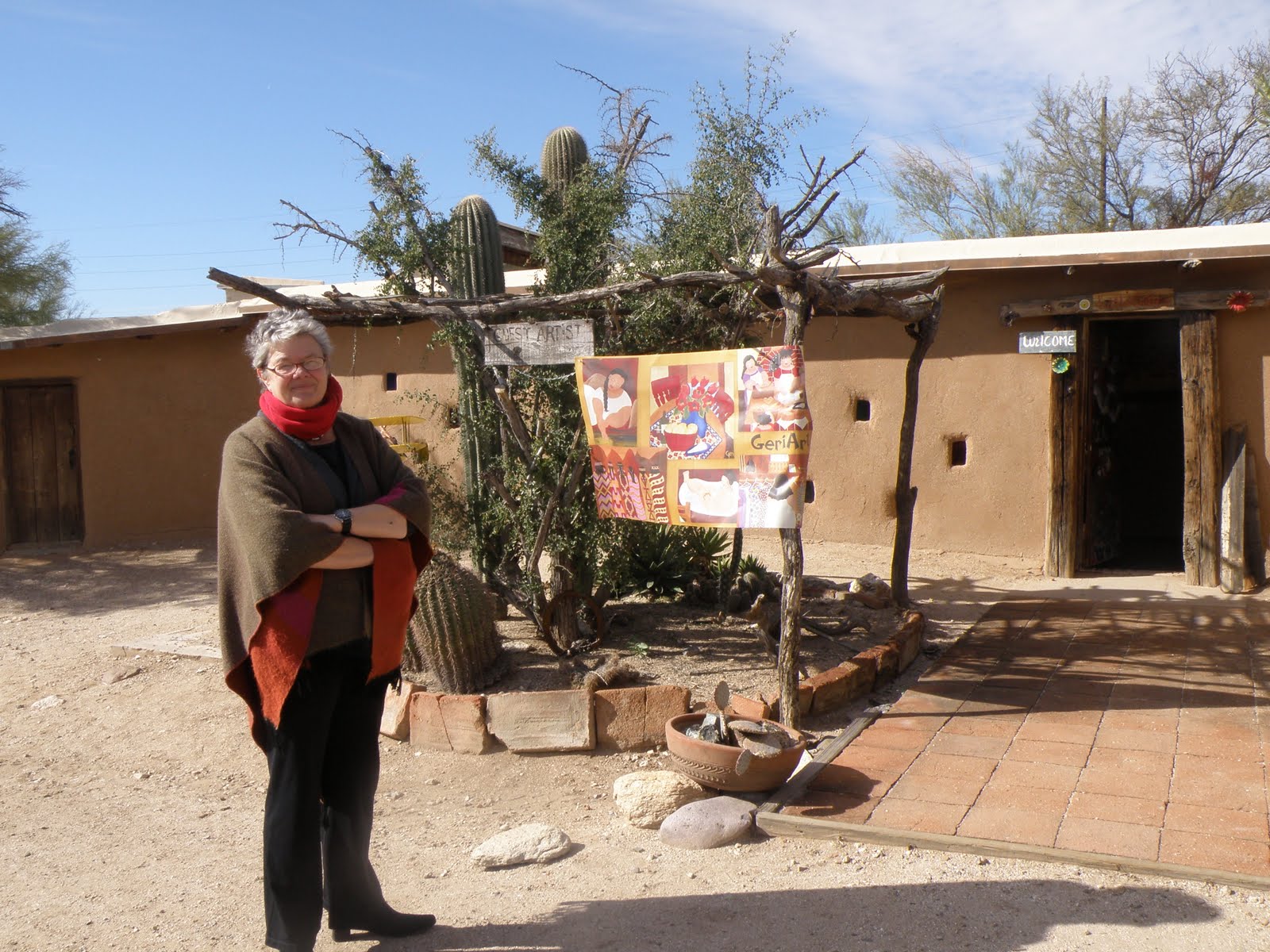
A Visiting Artist’s Studio sits to the side of the entrance. Geri Bringman was there when we visited. I love her work – she works in acrylics on canvas - her figures are colourful and delightful.

We traded our creative endeavours – Jacob’s Tails yielded a wonderful print that will find its way onto a wall somewhere in my life.

DeGrazia’s Gallery itself is room after room filled with his impressionistic sketches, paintings, sculptures of the South Arizona he loved and lived in the 40s, 50s, 60s and 70s. In addition to his physical environment, DeGrazia was enthralled with the Mexican Indian lifestyle and children. He was incredibly prolific and the entire complex is filled with his work. I remember the picture chosen by UNICEF for one of their Christmas Cards a few years back. But I did find a Chanukah Card there.

On our way to explore the Saguaro National Park – the RAINS started OMG did it rain!

We never made it up to Saguaro – instead we have come back to Casa Grande to spend our month retreat.

I never realized how much we actually did while we were in Tucson – our plan is to either do day trips while we are here or go back later!

Sunday, December 4, 2011

Doing Our YumaThing!

Would it surprise you to find out that we are again and still in Yuma? But things do change.

Our first shock was when we turned the corner towards KOFA (the Escapees RV Park we stay at) and all the orange and lemon trees had disappeared – we thought we were on the wrong road.

Bare fields or fields of alfalfa replace the orchards. The 40 foot high wind-machines that keep the frost from the plants sit in the middle of each field as the only reminisce of the acres of bushy green growth. The lemon tree grove across the street from the Park is no more!

As we explored the area, we found all sorts of orchards in various stages of development. Various rumours contend that the heavy frost killed off a number of the lemon orchards or the price of lemons had gone down so drastically that it was not worth growing them or that the groves were just getting to the end of their productivity. I think it is probably a little of each of these factors.

This was the only field we saw where each tree was wrapped and covered with burlap – never did find out why but I am sure it is some form of frost protection.

Fred and his new camera are almost inseparable – except when he goes over to the hot-tub (or SPA, as they call it here). Thanks to a great friend (Diane), he found out about the Magic Lantern series of Dummy books for beginner photographers on specific cameras and he managed to order one from Amazon and it arrived at John & Sallee’s place in just a few days.

It never ceases to amaze me when things work they way they are supposed to. Every once in a while he pops his head out of the book or away from the camera and make an innocuous statement like “Oh that’s the way it is supposed to work”. He doesn’t seem to realize that I don’t have a clue what he is talking about.

Actually some of his practice shots have been fascinating – like:

The Cotton bolls and fields

The old car and trailer

The Hummingbirds

Flowers


This internet is driving me crazy!! Sometimes it works and sometime it doesn't.

I finally got my articles and photos up for RV West - it took forever! I got the Newsletter done and have been eating too much.


We'll be off on Tuesday to
Tucson and then to Ajo or Casa Grande – we’re not sure where we’re going.

Thursday, November 17, 2011

Yes it is Beyond Next Week

I just got reprimanded because the last BLOG entry left us back at Yosemite and Coarsegold . . . h-m-m . . . we aren’t there any more. The reprimand came from Bill and Julie – folks we met and visited with at the Tropicana often over the last few years who stumbled across us here at Hi Jolly. In fact we left California over a week ago. It was starting to get cold and time to move on to warmer climes.

We did our Laughlin thing for a few days. We checked-in at the Tropicana but there were only four RVs there – the old sticker-oners – and a couple of RVs from California.

One of the reasons for going to Laughlin was to go to the IRS office to see if we could somehow get a tax exemption to realize some of the revenue from the Jacob’s Tails E-Book without the 30% hold-back. After spending over an hour with a very nice, rather useless IRS field agent, I honestly think it is easier to leave the 30% hold-back. We did try but won’t know anything for 4 to 6 weeks, when they will let me know by mail! This was truly a frustrating experience!

Anyway, I managed to get considerable pleasure from the pedicure received from my favourite pedicurist – small things can make me happy.

We’re at Quartzsite, now – at Hi Jolly again.

It’s nice to be back here. We’re parked up against the wash; we have water and feed out for the little critters; the hummingbird feeder is out; I have already seen Debbie (from the Authors Fair at Paul’s Book Oasis); and we’re settled in for a while.

Oh, I forgot to mention – Fred has gone photographical on us – that is to say, he has been having so much fun taking photos that he is no longer satisfied using the old Fuigi or sharing the Olympus with me, he decided he wanted his own camera. After Fred’s usual in-depth research, he decided on a Cannon Rebel with two zoom lens. Yes, folks – if we had a first born, we would have to give it up to pay for it. Actually it wasn’t that bad, but as we talked about it with Thom and Dar, it turns out that they had just the set up and they really didn’t want anymore.

Long story, short – Fred now has the photographic set up he wanted and is heavy into learning how to use it. Need I say, after the automatic camera we’ve had, this is a very steep learning curve!

Well, we’ve heard from some other travelling friends and it looks like all plans are a go and we should see them in short order.

Well, I think that should bring us up to date – for the time being, anyway. Our plan is to go down to Yuma next week.