Thursday, June 6, 2019

Costa Rica - Something like a local farm!


In contrast to the big Pineapple and Heart of Palm Plantations, we visited a local multi-crop farm. 
We wandered along a path through the various plants but it seemed to be very fast and not particularly instructive about their crops or processes.
I don’t have any real distinct memory of our tour prior to the demonstration of ‘how sugar cane is milled’; learning how to make tortillas; and the splendid lunch they served right there on the farm. There were a couple of interesting stone sculptures on the property.

Tourism has become such an important aspect of the Costa Rican economy that everything we saw and did was especially developed to speak to and entertain the tourist. The everyday life of the Costa Ricans is not hidden but there is little opportunity to explore their reality.
Anyway, back to the visit to the local farm.

Cacoa-cacao tree and cocoa tree
Seeds are used to make cocoa powder and chocolate
Cannonball tree 
The fruit is edible, but is not usually eaten by people because, in contrast to the pleasing fragrant of the flowers, the fruit can have an unpleasant odor. It is generally fed to livestock such as pigs and chickens.

Bananas have been a staple of Costa Rican economy for well over 100 years. Today, production and export of Costa Rica bananas are dominated by three huge, well-known companies – DoleChiquita and Del Monte, which harvest, package, and export bananas directly to world markets.

I’m not sure about the commercial side of growing the sugar cane on this particular farm

But they led us through the process of milling the sugar cane (on a small scale). 


The cane is cut, stripped and run through the rollers and it comes out juice.  Imagine!

And then they fed us lunch – with the tortillas we made and the juice from the sugar cane we milled.


So, not only do they grow the produce, they prepare it and feed you!
***************************************
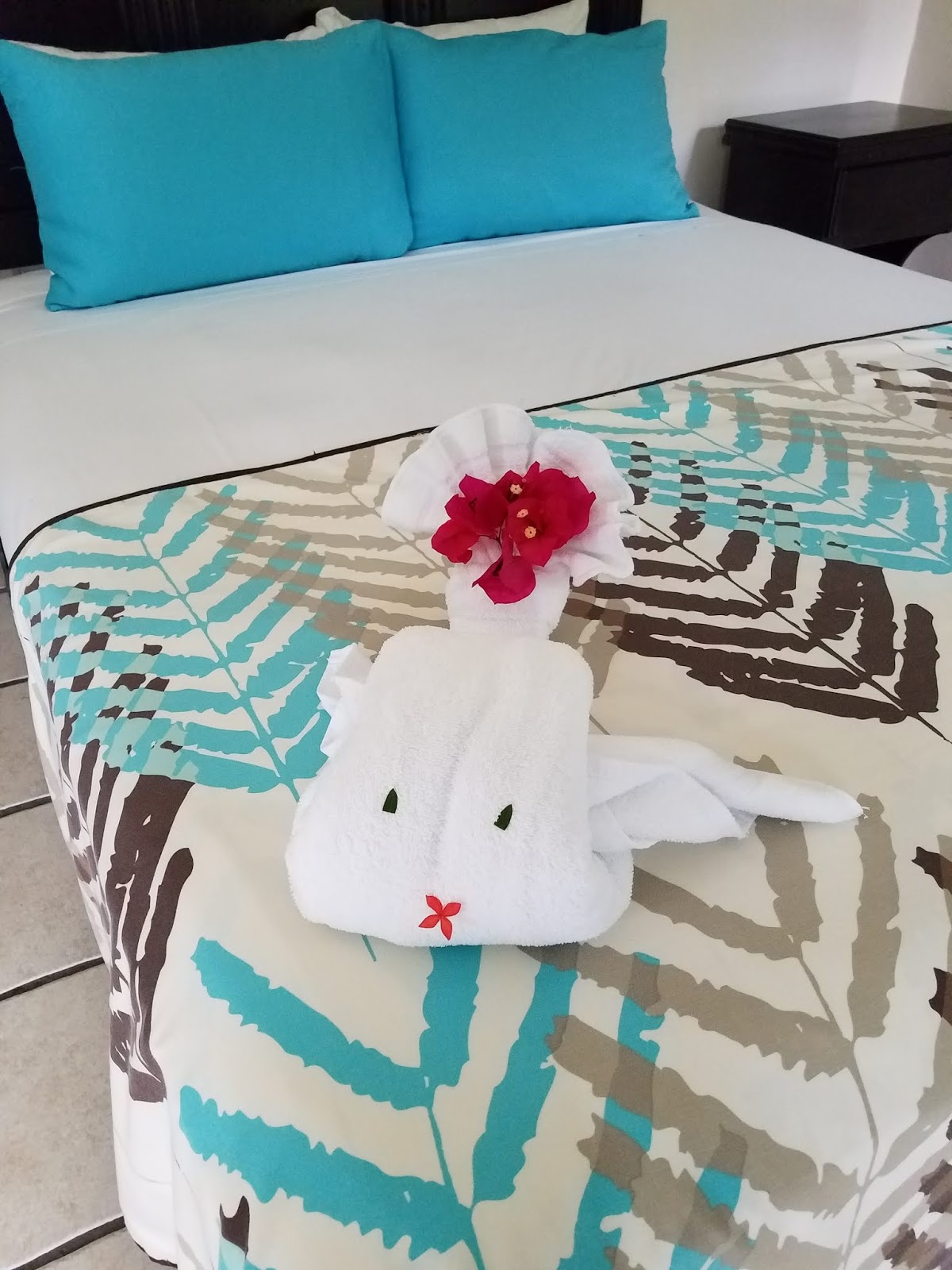
We moved onto the Arenal Volcano National Park area and so moved from a traditional-style living space at the Sarapiqui Rainforest Lodge to more resort-style accommodation at the base of the Arenal Volcano - Hotel Arenal Manoa – they classify it as Superior accommodations. And it certainly is!
Bright spacious rooms and great gardens just outside your patio doors. 
(The most amusing thing was that the first night, while I was lying there in bed, the light went on. I turn it off and in a while it went on again. I call the desk to come and fix it. There was no place to unplug it. They came and it goes off. An hour later the damn thing goes on again. I call them again. This time 2 come. They worked on it for about 15 minutes with no success. Finally they taped it up and left. It didn't come on again.)


 Next Episode, Arenal Volcano National Park!!

Sunday, May 26, 2019

Costa Rica – Pineapples; Heart of Palm; Close Encounters with Nature; Bright Cocky Birds and a School visit


(Wikipedia quote) “The economic sector of tourism began to develop in the 1980’s and is now the country’s main revenue source. Costa Rica’s rich biodiversity was being discovered as an important asset and plans for its protection were compiled. In the 1990’s everything accelerated and the government promoted tourism development on a large scale”
As far as I could tell, most of our guides were Costa Rican as well as experts or specialists in their fields. Those who guided us through the traditional and indigenous areas generally came from indigenous backgrounds.   The Government promotes and provides sponsorship for training as guides for the Tourism industry.

How the Pineapples grow – our first field trip
In Europe, almost 75 percent of pineapples are imported from Costa Rica; around 70 percent of plantation workers in Costa Rica are migrants - usually from Nicaragua.
Growing pineapple (that only started in 1970) has generated considerable controversy in this eco-friendly country because of the extensive pesticides, labour practices and so on but we visited a certified organic plantation.


So what is Heart of Palm?
I had never even heard of “Heart of Palm”. It is said to be rich in fiber, potassium, iron, zinc, phosphorus, copper, vitamins B2, B6, and C.  Not a lot of taste but an interesting texture added to salads.
It is harvested from the inner core and growing buds of certain palm trees. The farm we visited actually cultivates the palm trees for the hearts – some types of Palms grow suckers that can be harvested but often the tree is cut down; the bark is removed; and the white fiber layer around the center core (the heart) is exposed for harvest. 
As of 2008, Costa Rica has been the primary source of fresh palm hearts in the U.S.


Dave’s Natural Pavilion
Fascinating story this . . . Actually Dave and Dave’s Natural Pavilion (founded initially by Dave Sr.) was just down the road from the Sarapiqui Rainforest Lodge we stayed at. I manage to talk to Dave Sr. He was from California. In the mid 70’s he came down to Costa Rica, married and went back to San Francisco to educate their children. They returned to Costa Rica where he and his son have built the Natural Park “to promote environmental awareness through exciting up-close and personal encounters with nature” (quoted from the Mongabay News, 16 October 2013)
Time and my energy got in the way of exploring more of the Park but we were able to observe some of the birds that come to Park (Thanks to Jim and CJ for letting me use their photos in the BLOG).


Macaw Breeding Project
The Macaw Breeding site we visited is part of the Macaw Recovery Network. A Program that breeds rescued non-sustainable macaws and releases their young into the wild to help repopulate the wilds with these beautiful members of the parrot family.
This particular centre has become quite a Tourist attraction, complete with water buffalo.


Going to School!
Education has been free and mandatory for all the citizens of Costa Rica since 1869 and now includes over 4000 schools. Nearly 30% of the national budget is devoted to education.  Free education extends beyond high school in the public institutions where students can earn a BA Diploma accredited by the National Ministry of Education.
We visited a local 'model' school. Kids (around grade 5ish) all cleaned and shiny escorted us around and danced for us. Traveling with a bunch of North Carolina school teachers - they loved it.


Sunday, May 5, 2019

Costa Rica - The City (San Jose) to the Rainforest


Costa Rica  - WOW, what an experience!!!
The country itself is incredible - and the program offered an exceptional insight into the various aspects and environments of Costa Rica let alone both pre-Columbian and modern history.
It was a lot to cover in that limited period of time.


I've divided the Trip into three BLOG Posting and this - The City to the Rainforest is the first.

 We went from the city (San Jose) with a plaza filled with magnificent sculptures by Jimenez Deredia, a native Costa Rican.


To the National Theater


And the Gold Museum that became one of my favourite places. It contains 1600 artifacts dating back to AD 500  that show the cultural and ceremonial use of gold in the PreColumbian indigenous cultures. 


A local specialist guide navigated us through the various strata representing the world vision of Costa Rica’s indigenous peoples. There was so much more to see and digest, but time was limited.


 The conical house is a symbolic representation of the universe: the highest is SIBOKMO where Sibo’s (the creator of the earth) father lives- next is
a place of silence; there is a separate level where supposedly non-indigenous white people were created ( OKMA); (IRIRIA)  the place created for the clans to dwell. SULA KASKA that supports the whole cone is where noble souls go.
The Bribri social structure is organized in clans. Each clan is composed of an extended family. The clan system is matrilineal; that is, a child's clan is determined by the clan his or her mother belongs to. 
Next onto a roadside market


And after a lunch hosted at a local home – we travelled on to the Sarapiqui Rainforest Lodge built on the design of a 15th century PreColumbian village with palm thatched roofs with Hispanic Colonial and Indigenous influences that became our base for three jam-packed days.


Nature walks through the Rain Forest: identifying medicinal vegetation


PreColumbian Stone Sculptures, replicas, petroglyphs, traditional lodge structure 


And replica of a PreColumbian Burial Field 


Next posting will highlight some of the tours we took, like the local plantations we visited. 


Wednesday, April 24, 2019

Spring Communiqué

My Whirlwind of activity lasted right up to the time I left for Costa Rica in mid February. Not that my energy was well directed as I bounced from one thing to another but I managed to feel relatively satisfied when I left.
Actually the worst part of the whole trip was getting through the Airports and finding the right gates. Incidentally, I hadn’t been on a plane since the turn of the century.
In the airport, it seemed that you queued up to queue up. Even in the little Lethbridge airport first you queued up for your boarding pass, and then you queue up to go through security to wait until you could line up to get onto the plane.
The process is duplicated each time you change locations. The only difference seemed to be the length of the lines. The bigger the airport: the longer the lines – like a big snake slithering through a huge auditorium – following single file along the roped-off spaces until you reach the front of the line and they direct you to another line where you proceed to do the same thing along a shorter line.
When you finally reach the end of that line, you run the gamut of retail venders to find your gate so you can line up again to get onto the plane.
And the plane!! I did develop sincere empathy for sardines in the can, feeling extremely scrunched into seats that fit but leave no room for expansion – rather claustrophobic - I did manage to see a couple of movies though.
Even though San Jose, the capital of Costa Rica, is a city (about a million people) it felt like I was finally able to breathe my own air.
We went from the city (San Jose) with the sculptures, museum and theater to more traditional-styled accommodations that replicated indigenous buildings and sites. We spent three days experiencing walks through the rain-forests; road trips to a pineapple plantation; a heart of palm plantation; a Nature Pavilion that borders the rain-forest and attracts hummingbird; and another project that is breeds Macaws; as well as taking a boat tour on the Sarapiqui River.
After that jam-packed foray, there was a long day of travel as we moved off to accommodations close to the Arenal Volcano National Park. An excellent presentation about the volcanic formation of Costa Rica and a visit to an interesting multi-crop farming operation - coffee, pineapple, sugar cane -  and a demonstration of how they milled the sugar cane. An excursion on another river-boat took us on a bird, wildlife and crocodile hunt and a tour of a local school.
The Costa Ricans are so proud of their Eco-supporting environment, as well as government sponsored education and health care. It is a very comfortable country.
The final accommodations were certainly a multi-starred community with close-by ocean out-rigging opportunities; a butterfly gallery; a orchard garden; surfing; beautiful sunsets; and again wonderful food.
The trip back to Vancouver was even worse than getting to Costa Rica: more line-ups; more waiting time; just as squished; on top of which, I was totally exhausted.
Back in Vancouver, I managed to pick up a bit of a breathing bug (probably from the plane), but I toughed it out so I could get a chance to see my brother (and his wife, Patty) who were coming in from Mexico. It was good to have all the siblings together even if it only for a couple of days.
Would I do that kind of trip again? The jury is still out!
So now back to the challenges of day-to-day life.
Having said that, one of the gals from the trip suggested that we take a road trip to Montana. Why not?
We are hot on the trail of finding out where we want go and places to stay – such fun!!!
The only thing as much fun as going to new and interesting places is showing off places you love to someone who is interested in seeing them.