Saturday, March 31, 2012

Chiricahua National Monument: An Other-Planet Experience

It’s so difficult to describe Chiricahua National Monument. I was sure we had left planet Earth and travelled out somewhere far, far away in another galaxy.

The Park sits in Cochise County in the South-East corner of Arizona. The diversity is unmatchable. To get there, you travel along a valley floor through fairly desolate prairie lands (especially this time of year) to the gateway of the Chiricahua Mountains.

The Faraway Ranch sits between the Gate and the Visitor Center and is worth a look-around to understand how this area developed and then became a tourist destination.

Beyond the Center, Bonita Canyon winds through all sorts of rock formations. They call the park the Wonderland of Rocks and as you travel along, you can understand where that name came from.

Columns and pinnacles of rock rise skyward out from  the vegetation.

01

00

These huge, vertical structures were (and continue to be)created from erosion penetrating joints in the soft volcanic rocks.

Travelling further into the park, the view expands and widened and you get a different picture of the extraordinary power and beauty of Nature.

02

04

03

06

05

Chiricahua was certainly one of the highlights of our 2011-2012 Winter.

Friday, March 16, 2012

Spring has sprung, the grass is ris: I wonder where da birdies is

The Why/Ajo, AZ area did not meet our expectations for bird watching or even stalking the wild flowers. We did see some old bird friends and some old human friends (Tracy and Stan were on the other side of another wash and Chuck and Sheila were parked out behind Ajo) but we were quite disappointed in the bird watching.

phainopepla-male-edited phainopepla-female-edited

male phainopepla female phainopepla

Road-runner (13)edited

Road-runner

Our rule of thumb has been to move on when our waste tanks are full – but this time we didn’t wait because Why came under a GREAT WIND STORM threat so we headed towards Tucson. Well we did not miss the dust entirely - the MH and the car were covered with dust from one end to the other.
The only pavement we knew about was the Casino but that didn’t satisfy the spring-fever bug to find the illusive birds. Our thought was to go down to Patagonia but decided to check into the Escapees RV Park at Benson (Saguaro Co-op) to get out from underneath all the dust and dirt and venture out on day trips from there.

The Escapees Park at Benson is much bigger than we are used to and very resortish which we are also not used to but it served its purpose and gave us a non-dusty place to vacuum, clean and explore places we had not seen at all or at least not in the past 7-8 years.

P3050001

BTW – this shrub was on our site and I have no idea what it is. Can anyone out there help me identify it?

P3050004

IMG_4963Our first venture was to the Patagonia area – a place noted for viewing birds. We followed Highway 83 to Sonoita and then down to Patagonia. Spring hadn’t quite arrived there yet (a rather bleak, hilly trail not unlike our prairies to foothills in the late fall). We were surprised to learn they are promoting wine and vineyards in this area. Mind you, we didn’t see any sign of grapes growing – the best sign we saw was the Welcome sign for Sonoita.

We had been to Patagonia before but that was about eight years ago. There always was a bird-watching mood about the area but it now seems to have become a haven for artists, as well as the birders. We visited the State Park but we were too early for some and late for others to see many birds so we stopped at Pattons Hummingbird Haven.

What used to be a private home is now open to the public. Unfortunately a Red-tailed Hawk arrived just before we did and there was a mass exodus of the majority of smaller birds. We stuck around for a while, but only saw a couple of interesting friends.

The Gila Woodpecker is the clown of the bird kingdom. Here he was after the suet but we’ve seen them upside down trying to drinking out of the hummingbird feeder.

CARDINAL-EDIT (2)

Cardinal

GilaWoodpecker

Gila Woodpecker

Onto the San Pedro House (Riparian National Conservation Area) and a wonderful place to wander, sit and watch all the activity.

P3040001 P3040015 Cardinal2

IMG_5015

The most outstanding venture we took was to the Chiricahua National Monument – the Wonderland of Rocks.

Even with all the Geological marvels we have seen – the Chiricahuas are by far the most extraordinary. So spectacular that they deserve a separate BLOG entry (this will come later).

We left some sights unseen (for next time) and wandered up to Casa Grande for one last visit before we started our meandering northern trek.

Next stop – Quartzsite and High Jolly.

Wednesday, February 22, 2012

Our Love-Hate Relationship with Yuma

From Casa Grande, we met Sheila and Chuck for a few days on Darby Wells Road – the trail that circles around the mine at Ajo.

Fred, Chuck and Sheila went out exploring the road and found this interesting Cemetery they said was Mexican.

DarbyWellsCenetary (2)

DarbyWellsCenetary (5) 

DarbyWellsCenetary (4)

We had been told about a place in Sells, (the centre of the Tohono O’odham Nation) that served traditional Tohono O’odham food and finally found the Desert Rain Cafe. As Betty said “Every item on the menu has at least one ingredient which has been part of the traditional Tohono O'odham culture. Hummus made using tepary beans, agave used as sweetener. My favourites were the dark tepary bean hummus and the Cholla bud Salsa: Fred liked the Prickly Pear salad dressing. Different and delicious.

Organ Pipe Cactus National Monument

We took the van tour again. This time our guide was Sardius – otherwise known as Ranger Rick because nobody could pronounce his name, His passion is the cacti and he managed to find ever so many anomalies for us to o-o-o-o and aw-aw-aw over.

P1160017    

DSCF0002

P1150002

P1160018

There is an abundance of cacti up around Ajo and the mine but there was little other vegetation and therefore, wild-life or birds. I think I like the Why area better though

Our Love-Hate Relationship with Yuma

We have an interesting Love/Hate relationship with Yuma: we keep going back and we keep leaving!

Mostly, we are drawn there by the best winter weather in the US Southwest; some exceptionally good friends; an easy trip to Algodones, Mexico; good shopping; and an Escapees Co-op Park that offers good spaces, good laundry; good people and a great hot tub.

On the other hand, we have been there so often and toured the area so much, there is not much new to find. As  Sheila says, we’ve just seen too much. So, after we spend good quality time with friends; do our Algodones thing; shop ourselves out (or run out of space-whichever comes first); and spent too much time in the casinos; we are ready to leave the city.

Well, the four of us (Sheila, Chuck, Fred and me) headed off to California and Ogilby Road.

And we thought we had done our visiting!!

First we got a phone call from Don and Jan saying that Jan had fallen and broke her ankle so we wanted to visit them while they were still around. Then Stan and Tracy, a couple we met at the RV Lifestyle Seminars in Kelowna some eight or nine years ago – then they came out. Then an email from Colleen and Marc, new RVers we first met in Casa  Grande a month or so ago; then Judy and Terry emailed that they were coming out!!

Busy, busy busy – it’s tough to have quality time with so much company and it’s nice to have friends that you can tell that you just can’t take so many people all at one time and they understand and are not offended!

While we were out there, Chuck and Sheila got the sad news that a friend of theirs had been killed in an ATV accident near Florence, AZ.

We consoled ourselves by finding one of the finest Mexican buffets I have experienced. We did a day trip up towards Indio, CA did a bit of casino hopping and came back pleased; stuffed; and readily comforted.

Our rule-of-thumb (when we are dry camping) is to move when the waste tanks are full and that usually takes around 7 to 10 days  - Our next move was back to Casa Grande for a massive clean-up; re-energize; and re-stocking.

So now we are back at Why and feeling somewhat liberated. We’ve only been here for a couple of days and Fred has been out taking pictures and I have been working on this post and enjoying watching the birds and little wild things.


Monday, January 23, 2012

My Cotton Story

Hard-copies of "Jacob's Tails. . .ALL GONE!!

(The last 4 copies were left at In-a-Pear-Tree in Casa Grande)

*****************************

The E-Book is available through

Smashwords

***

Barnes & Noble

***

Chapters/Indigo

*****************************

By the time we left Rovers Roost, Casa Grande, (January 12, 2012) we both felt the need to get back to the desert.

Rovers Roost is a great place to spend our mid-winter park time – we do enjoy the attitude; the activities; and the camaraderie. Our Escapees buddies, Diane and Andy introduced us to Shelly and Bill and Miles (an 8 month old Scotty) who became Escapees buddies very quickly. But – we miss the space and quiet.

I was able to initiate exercise sessions three times a week using the same Strength for Seniors series that they had at POS, Coarsegold (near Yosemite) and folks seemed to enjoy it. Katy took it over and I expect it will still be going on when we get back next year.

I’ve Always Loved Cotton!

While we were there, I again became intrigued with the cotton in the fields: how it grew and was harvested. Then there was the cotton gin down the road from the park - the whole yard was just packed with those huge cubes the size of railway cars.

For years we had seen those massive bales sitting out in the field and on a rare occasion, we saw a field with plants and straggles of cotton clinging to them. This year there were still crops sitting in the fields: some still maturing; some ready and waiting to be harvested; and we were even able to finally see the machinery harvesting the cotton.
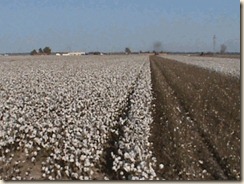
HeatonPickers

Working Field2

cotton1

They don’t pick by hand any more!

To this point my total exposure to harvesting cotton was from movies that showed folks in the field with sacks on their back bent over and picking cotton and singing.

The machinery is fascination.

First came the picker-

cottonpicker2

that could pick one row at a time. The invention of the mechanical picker, apparently revolutionized the South. They claim that “the picker played an indispensable role in the transition from the prewar South of over-population, sharecropping, and hand labor to the capital-intensive agriculture of the postwar South.

Today, they pick up to six rows at a time.

NewPicker1

and dump the cotton into the basket in one operation.

Compacter

And then it goes into the compactor.

NewPicker

And it comes out here!

Those huge modules (as they call them) sit on the road beside the fields until they can be ginned – that is the cotton is cleaned separated into fibres and seed.

It used to be done painstakingly by hand

image

until Eli Whitney finally patented his Cotton Gin (short for cotton engine) in 1793.

Another stroke of Luck!

We went over to the Lummus Cotton Gin (just down the road from where we were staying) and I sat with a couple of gals there and they explained some of the ins and outs of the industry to me.
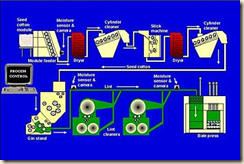
image

(This is a copy of the Diagram of a modern cotton gin plant, displaying numerous stages of production from Wikipedia)

There is considerably more cotton this year because of the higher prices. Over 600 modules of raw cotton sit in their yard. Usually they are finished processing the cotton by mid January. This year they guesstimate it will be March before it is all done. Cotton Gin Yard (9)

The ginning process cleans the raw cotton and separates the modules into cotton fibres for fabric (that is compressed into bales) and the pyramids of seed that sit in the yard. The gals at the Plant said that one module will produce about 15 bales.

IMG_4631

And seed that is used in all sort of things like animal feed, fertilizer and cotton seed oil. The oil is then refined further for lotions and soaps.

IMG_4635

There is talk about using the rest of the waste for biofuels.

They lose track of the bales after they are trucked to a cotton broker. The gals figure that most of the fibre goes overseas to be spun and woven into fabric.

So – that’s my Cotton Story!

http://en.wikipedia.org/wiki/Cotton_picker

http://eh.net/encyclopedia/article/holley.cottonpicker

http://casa_grande-az.yellowusa.com/Cotton_Gins.html

http://en.wikipedia.org/wiki/Cotton_gin#Modern_cotton_gins

http://inventors.about.com/od/cstartinventions/a/cotton_gin_2.htm

Sunday, January 8, 2012

Saguaro National Park: Bookend Parks of Tucson

Rovers Roost (Casa Grande) become our base and we have gone back and forth to Tucson a few times.

The first trip was to West Saguaro NP. West and East Saguaro National Park sit like bookends on either side of the city. The West side seemed to have more of what we wanted to visit.

It made me think of a forest – if there is such a thing as a Cactus Forest.

A Ranger recommended that we might like to try the Signal Hill Trail that led up to some interesting petroglyphs (Rock Art) and a great panoramic view.

The area was developed by the Civilian Conservation Corp (CCC) who were FDR’s answer to unemployment during the Depression of the 1930s.

Corps of men were fed, educate, housed and paid $1.00 per day (75% of which was sent back to their families) in exchange for developing the various national sites.

They think that the petroglyphs were left by the Hohokam people thousands of years ago. There is little know about these people or the rock art that they left behind but it is probably akin to the graffiti of today.

IMG_4541

IMG_4544

The Saguaro Cactus is fascinating – from it’s humble beginning to its haunting shape that’s become a symbol of the desert for me.

The Saguaro can only propagate from seed and under specific conditions. It is very sensitive to frost and wind and needs heat and moisture. The Saguaro is found only in the Sonora Desert.

The cactus usually begins life being sheltered by a "nurse" tree or shrub (a Creosote, Mesquite or Palo Verde) that provides shade and moisture to help it grow. So you often see the Saguaro surrounded by bushes.

Eventually the cactus takes most of the nutrition and the nurse plant dies.

IMG_4549

The Saguaro grows very slowly –maybe an inch a year - but to a height of 15 to 50 feet. The largest plants, with more than 5 arms, are estimated to be 200 years old. An average old Saguaro would have 5 arms and be about 30 feet tall. The one in this photo has 7 arms and we’ve seen cactus with a whole lot more.

Prickly spines run vertically along the entire length of the cactus. After a heavy desert rain, the spines are further apart when the cactus swells by absorbing the moisture. As the desert dries out, the spines come closer together,

It’s almost impossible to find a Saguaro that has no damage. Birds (particularly the cactus wren) build their nests time and time again in small holes in the cactus. Once there is a nest there, the cactus develops a kind of callus around it to conserve the moisture and protect itself. This callus is what they call a boot.

I’m not sure if you would call it an injury, but a crest can develop on the top or between the arms of the Saguaro. A friend of ours (Sheila) has a list of highway mile markers where she has seen the crested Saguaro.

PC090068

The question that puzzles me the most is: What triggers the growth of an arm? Every time I ask, I get a different answer: when the rains are heavy, the arms allow the cactus to absorb more moisture for when there is a drought; because the Saguaro only propagate by seed, more arms develop when the plant seems threatened; and finally, why do other trees produce their branches? Interesting, eh?

Cactus-Why (3)

Monday, January 2, 2012

The Arizona-Sonora Desert Museum

The Museum sits on 98 acres with 3.2 kms (2 miles) of walking paths covering 21 acres. Much of the property is covered with natural growth and cacti.

IMG_4355

Hedgehog

Hedgehog

Saguaro Cactus with Crest

CrestedSaguaro

A Crest can be developed when the growing point, or merristem (which produces new stems and spines or leaves), elongates into a line. In time the growing line may become greatly convoluted, like a brain. This phenomenon has been observed in nearly all plant species; its cause is generally not known”(sign near the cactus)

SuguaroCrest

The Museum offers all kinds of guided tours and demonstrations throughout the day. We chose to go to the Raptor Free Flights demonstration that featured a Peregrine Falcon.

There were three trainers working the birds. They were able to communicate with each other and could somehow direct the flights of the birds. The birds would dive and swoop down over our heads and then  perch on a branch or cactus to have their pictures taken. Like I said, we took over 150 photos – it was so difficult to decide which ones to share!

Raptors

Owls

BarnOwl

Barn Owl

Owl

Hawks and Falcons 

Falcon

IMG_4370 (2)

IMG_4373 (2)

IMG_4391 (2)

IMG_4393 (2)

IMG_4395 (2)

Hummingbirds

Hummer (1)

Hummer (2)

Hummer

Resting Cougars

Cougars

Bob Cat

BobCat

Need I say it was a memorable visit?