Monday, August 5, 2019

Costa Rica - Cruising Down the Rivers . . . Birds and Beasts

Click on picture to enlarge

The rivers tours were not my favourite but offered some interesting sights.
We did trips along both the Sarapiqui River and the Tárcoles River hoping to see all kinds of birds, wild-life and local development. The boats were covered and open, built especially for tourists to view the birds and wildlife along the shores. Unfortunately, because of the lack of rain, the rivers were low and the river banks were deep and wide. The birds and wild life were way over there and without binoculars or zoom-lensed cameras the viewing was limited.


BUT having said that, folks on the tour contributed lists and photos they took, so not all was lost. Our guide was great in pointing out the various bird and wild-life, even if I couldn’t see them.

The Sarapiqui River is a tributary of the San Juan River and helps irrigate this region. It winds through dense rain forests. It’s very important for water resources and biodiversity protection of the area.


There was a turtle along the way but the most interesting thing was the Anhinga (snake bird) we encountered.
It is a water bird, sometimes called a water turkey. It earned the description as a snake bird because when it swims, only the neck appears above water and looks like a snake ready to strike. As well we watching it skim along the water; we caught it sunning itself on a log while it dried out its wings.


 The Tárcoles River is reputed to be one of the dirtiest and most polluted in Costa Rica carrying about 67% of sewage and industrial wastes of over 50% of the country’s population. It is about 111 km long and the watershed covers up to 2,121 kms. BUT it also houses one of the world’s largest crocodile populations with about 2000 in the area (about 25 crocodiles per square kilometre). (Costa Rica Journeys - September 6, 2011).
The one we encountered was extremely docile and didn’t even disturb the egret wandering along the bank.


Birds

Kay, a fellow traveller recorded sighting about 68 birds . . .

With the help of others (with special credit to Jim), here are some of the birds we captured digitally:


Bare-throated Tiger-Heron

Black Vultures
Great Curassow

Crested Guan
Great Blue Heron
Green Honeycreeper
Montezuma Oreopendola
White Hawk

Passerini
Red-legged Honeycreeped
Reseate Spoonbill
Social Flycatcher
White-necked Jacobin

Yellow-throated Toucan
 Beasts:

Howler Monkey

Iguana
Sloth
Vaughnda on the Water Buffalo

Onto the Butterflies and the Orchid Gardens

Sunday, June 30, 2019

Costa Rica’s Sleeping Volcano - Arenal


We travelled out of the rainforest area into the more mountainous terrain settling in the shadow of the Arenal Volcano (about 90 km NW of San Jose near the town of La Fortuna) – a magnificent sight. Arenal is one of hundreds of volcanic formations that make up the chain called the Central American Volcanic Arc (CAVA) that extends parallel to the Pacific Coast line from Guatemala down to northern Panama. 


As with most volcanoes, the Arenal Volcano Mountain is conical shaped but it rises over 1500 metres. It is crowned with a crater measuring about 140 metres across and three more craters developed during a 1968 eruption (See above picture that shows how the development of the craters).
Arenal Volcano area is an important watershed for the Arenal Lake Reservoir. The reservoir's water is used for hydroelectric power that is connected to the national system.
Although they consider the volcano dormant, there is still limited volcanic activity on the mountain.
In 2010, there was an avalanche and volcano. Travel onto the mountain is not recommended – it is still not regarded as being safe.
(https://www.arenal.net/eruption-photos/may-24-2010-avalanche-and-recent-changes-arenal-volcano)
The museum at the base of the mountain traces the volcano’s activity over the past century along with the wildlife that inhabits the area. 


 The Lodge is starting point for a number of trails and is built to give the visitors a spectacular view of the mountain. 

 
The décor is so colourful - ceramic wall decorations, a fanciful pond, decorated separations in the restaurant and a simple but appealing Costa Rican lunch.


 This is where we discovered the great idea of putting small scissors in with those annoying little packages of condiments that you can’t open.


Thursday, June 6, 2019

Costa Rica - Something like a local farm!


In contrast to the big Pineapple and Heart of Palm Plantations, we visited a local multi-crop farm. 
We wandered along a path through the various plants but it seemed to be very fast and not particularly instructive about their crops or processes.
I don’t have any real distinct memory of our tour prior to the demonstration of ‘how sugar cane is milled’; learning how to make tortillas; and the splendid lunch they served right there on the farm. There were a couple of interesting stone sculptures on the property.

Tourism has become such an important aspect of the Costa Rican economy that everything we saw and did was especially developed to speak to and entertain the tourist. The everyday life of the Costa Ricans is not hidden but there is little opportunity to explore their reality.
Anyway, back to the visit to the local farm.

Cacoa-cacao tree and cocoa tree
Seeds are used to make cocoa powder and chocolate
Cannonball tree 
The fruit is edible, but is not usually eaten by people because, in contrast to the pleasing fragrant of the flowers, the fruit can have an unpleasant odor. It is generally fed to livestock such as pigs and chickens.

Bananas have been a staple of Costa Rican economy for well over 100 years. Today, production and export of Costa Rica bananas are dominated by three huge, well-known companies – Dole, Chiquita and Del Monte, which harvest, package, and export bananas directly to world markets.

I’m not sure about the commercial side of growing the sugar cane on this particular farm

But they led us through the process of milling the sugar cane (on a small scale). 


The cane is cut, stripped and run through the rollers and it comes out juice.  Imagine!

And then they fed us lunch – with the tortillas we made and the juice from the sugar cane we milled.


So, not only do they grow the produce, they prepare it and feed you!
***************************************
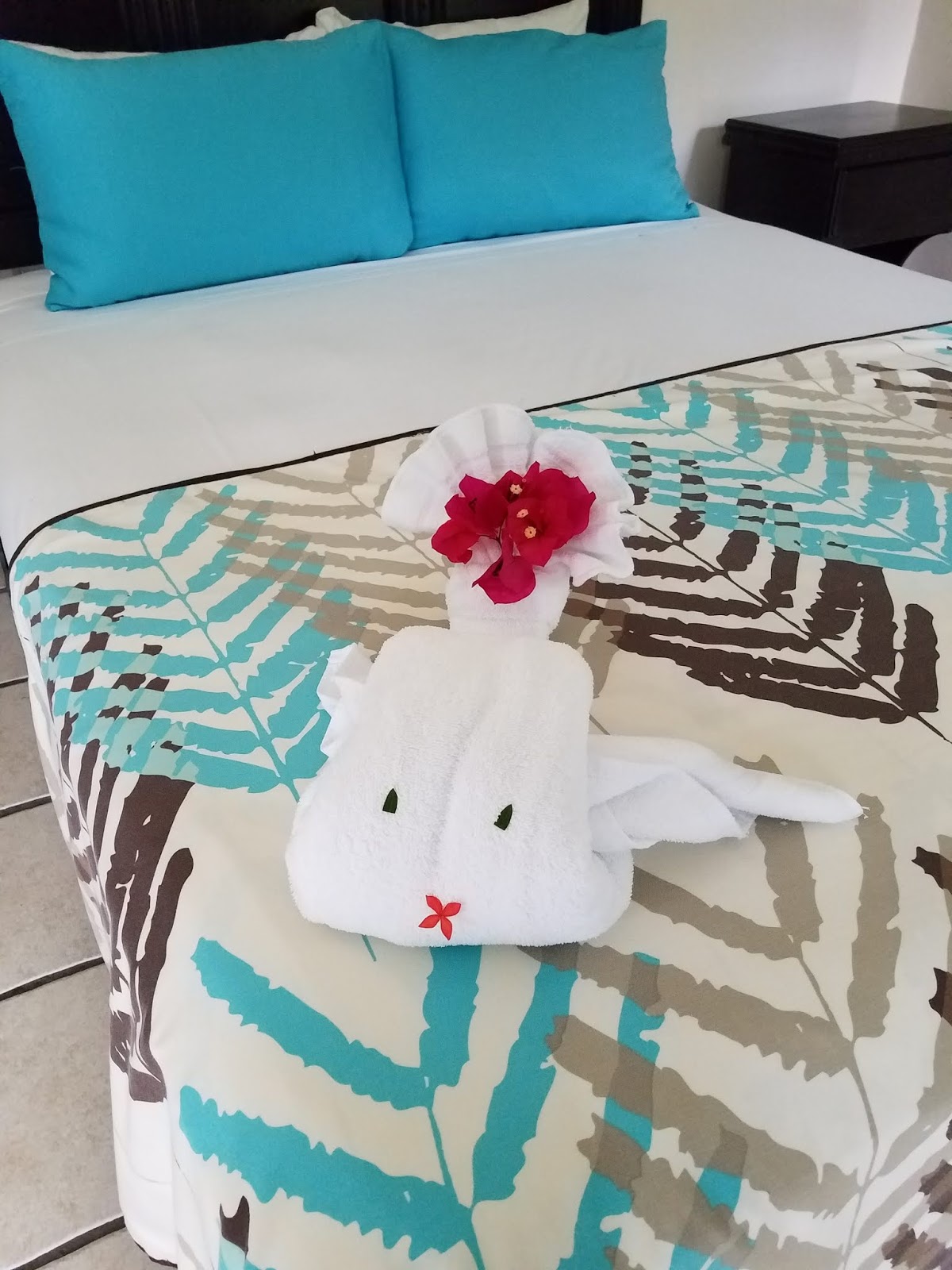
We moved onto the Arenal Volcano National Park area and so moved from a traditional-style living space at the Sarapiqui Rainforest Lodge to more resort-style accommodation at the base of the Arenal Volcano - Hotel Arenal Manoa – they classify it as Superior accommodations. And it certainly is!
Bright spacious rooms and great gardens just outside your patio doors. 
(The most amusing thing was that the first night, while I was lying there in bed, the light went on. I turn it off and in a while it went on again. I call the desk to come and fix it. There was no place to unplug it. They came and it goes off. An hour later the damn thing goes on again. I call them again. This time 2 come. They worked on it for about 15 minutes with no success. Finally they taped it up and left. It didn't come on again.)


 Next Episode, Arenal Volcano National Park!!